Wednesday, 12 April 2017

Changes to Enterprise - with the customer in mind

As flagged earlier, we've been actively considering where our interface with the customer falls short & how we can improve what we currently offer.  We've had a few breakthroughs that I'd like to share.  While these are still in final test phase, and will be implemented in April and May, I think they're worth documenting.

We are about to make three changes to Enterprise, two of which will become standard across all libraries' Enterprise sites & one that allows for each library to decide how it will implement the change.

The "standard" changes relate to 1) making additional e-content (Zinio & Lynda.com) discoverable through Enterprise, and 2) making a local South Australian community information database available in Enterprise.  The 3rd change provides a little more nuance around increasing the amount of local content that is displayed in many searches undertaken by library customers.  Give the complexity of explaining these 3 changes I've decided to restrict this post to the 1st change we're making and then explain the other two changes in another post or two.

Zinio and Lynda.com discoverability in Enterprise:  These two products are currently not discoverable using the SirsiDynix eResource Central (eRC) product.  We've heard that it will be some time until these two products will be discoverable in Enterprise through a metadata harvest through eRC.  So we've decided to implement a "workaround" using the functionality of Portfolio - the digital asset product we also subscribe to from SirsiDynix. 

James Kemperman (of PLS) has created digital objects in Portfolio, that are then harvested by Enterprise, and display in people's search terms.  Our network subscribes to approximately 400 different e-magazine titles through Zinio, so James has begun creating a record for each title, that then become discoverable.  For example when someone searches for something like Organic Gardener, in their search results they will see this record. See the image below. (And I apologize for the quality of the pics - they're screenshots that don't scale very well in the limited functionality of this blog software.) 

If you click the link, you will note that the hard copies of the ABC Organic Gardener display for various libraries, along with the e-magazine record. 


The record is not perfect, because we can't mask the second URL in the record - that just links to the cover picture.  However we're hopeful that by adding the "ACCESS HERE" in front of the 1st URL customers will quickly get the hang of how it works.  Another "downside" is that the record for this e-magazine is shown as an "asset" in the search facets on the left hand side, along with all other Portfolio records, rather than being included in the list of Magazines.  So someone who limits their searches to magazines will not see the e-ones. 

And once a customer clicks on the record in the list they will see this image:

This provides all the information about how to download the magazine to various devices & how to get the App for whatever your device is.

As I've said this is a work-around - not perfect, but an improvement.  We'll be adding records for all titles in coming weeks.

Lynda.com: is a bit like Zinio, however the Lynda.com subscription provides almost countless courses & we don't want to include everything, as it will clutter the database unnecessarily.  So we're looking at usage stats to include courses that have proved popular in the past, as well as asking library staff who are doing training in digital literacy to nominate courses that they would like to see highlighted for customers.  That way, the trainers can point their trainees to Enterprise and get them to find the Lynda.com courses that are part of the course they're doing.

An example of this is seen here, where if a person was to search for javascript in Enterprise, one of he records they would find is a link through to a course.  Below is an image of what the record looks like in Enterprise.  
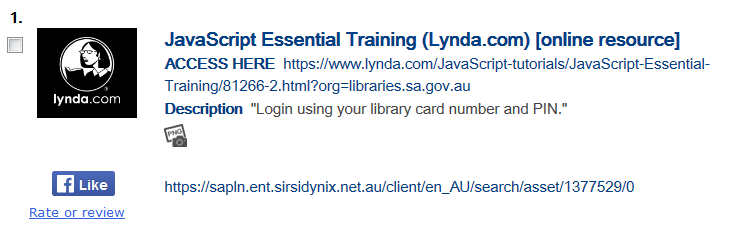
You will note that we have included the instructions "login using your library card number and PIN" in this record, so people get the idea that it isn't a book or DVD.  Clicking on this link will take the customer out of Enterprise and to the Lynda.com login screen.

Hopefully this temporary work-around will increase the discovery and use of these two e-resources while we wait for eRC to catch up.  As we're already paying for the online products it makes sense to find any possible way to maximize their use.

I'll post on the other two changes to Enterprise in the near future.


Friday, 31 March 2017

New "One Library" consortium created in Western Australia

I have been following with interest the progress of a consortium of 11 councils in south western Western Australia as they've been developing a library consortium, which will operate in a similar manner to our State-wide OneCard  system in South Australia.  They have developed an interesting logo which is a stylised map of the regions that the participating councils cover.

The consortium has commenced its public announcements about its intent and has commenced converting libraries onto their new Library Management System and has announced their intent to their communities.  This has received media publicity.   

The 11 councils involved span from about 100Kms south of Perth at Waroona all the way to the south coast of WA at the Walpole library.  The consortium will include 23 libraries, serve a population of almost 200,000 people and include over 500,000 items in their collections.  And it is interesting see that the consortium has chosen SirsiDynix as the providers of their Library Management System which enables the consortium.  This is the same software used by the OneCard consortium in South Australia. 

Various councils have provided information to their communities outlining how the consortium will work & what the rollout timetable is for all members of the consortium.  They intend to have all libraries onto the new system by July this year.  Information on the Bunbury and Manjimup council sites provide useful information about the operations of their consortium.

While this consortium only covers 11 of the 140 councils in WA and covers about 8% of the state's population this is quite an achievement, and is a good start to what could provide a model for other councils in the state. 

From my perspective in South Australia, and considering the success of our consortium here, it great to see another group of likeminded councils considering that their communities will be enriched by pooling their library collections and sharing them with their neighbours. This spirit of cooperation can only be a good thing for the communities they serve & strengthen the place that libraries have in their communities. 

Wednesday, 29 March 2017

User Experience - incremental & radical change

My last post began a general conversation about the library users' experiences, particularly in relation to our online services and products.  As I indicated, I'd like to take this discussion further to look at our current products and services, how they do or don't work and what we need to do to fix them.

I think a key issue here is that while we know some of what is wrong with our online presence, if we're talking about the users' experience then we need to find effective and efficient ways of testing our services with our users to make sure that changes we make are things that they want to see & that they know will improve their experience.  

Having said that, there are certain standards and metrics that can be used to determine product effectiveness even before users are engaged in providing input into design. For example, there are Web standards to make sure that the content of websites is accessible to people regardless of their disability. 

We also know that more than 30% of all web browsing/use is done from a device other than a computer - i.e. some form of mobile device - a phone or a tablet etc.  So we need to make sure that we can provide a positive user experience on various devices.  Are we doing that at the moment?  No, not to my satisfaction

And more broadly, what works well or doesn't work well in our consortium's online offerings?
  • Finding and using Enterprise on a mobile device?  I don't think so.
  • Registering as a new library user online?  No
  • Finding and accessing e-books? No
  • What about e-magazines, or other content we provide such as Lynda.com, Ancestry? Not really.
  • Keeping customers informed about library offerings (new books, events etc) in their areas of personal interest?  No.
Is there anything that we can point to where our online offerings are so good that we don't want to change them?  I can't think of any, but would love to hear from anyone who can point to areas of excellence in our online offerings.

So - what are our options?  I think that there are three options available to us:
  1. Work with the vendors of the current products we're got to seek incremental improvements where this is achievable
  2. Look for new / replacement solutions that are clearly superior in providing for the customer
  3. Look for radical solutions that may allow us to co-design and co-develop new solutions that take the user into account from the design foundations.

I don't think that these options are mutually exclusive.  In fact I think that we need to be actively pursuing both incremental changes while also exploring visionary opportunities.   And of course anything that we do also needs to ensure that any changes that we propose have been given the User Experience (UX) tick of approval. 

I believe that we do have options in the three areas I have mentioned above.  Therefore PLS is exploring various options in all three of these areas & we look forward to working with libraries over the next year or so in all of these options.  We do have some improvements in the pipeline & others will come to fruition over time with library staff participation. 

Monday, 13 March 2017

User Experience - what is it & why is it important to libraries?

I’m writing this fairly long post to lay the foundations for work that PLS and libraries are currently doing & plan to do lots more about in the areas of improving the library users’ experience – particularly in the online world.  I’ll be following up this general post with some specific information in coming posts.  These future posts will discuss our library network’s digital strategy and how this needs to be directly connected to the library users’ experiences of our online services.

It’s interesting how the computer industry has used everyday language and given it a very specific meaning, or is using simple English words in totally new ways.  So a cache which in everyday use has always meant a “a collection of items of the same type stored in a hidden or inaccessible place” is in computing terms, a part of a computer that “…stores recently used information so that it can be quickly accessed at a later time.”  So the original meaning was a hidden and perhaps inaccessible store, while computing thinks of a cache as a way of making information more readily available.  Likewise, we all know what a cloud is, but what does the term cloud computing mean?

So it is with how the computing / digital industry is using the term User Experience.  They have even given it its own slightly quirky acronym UX (rather than UE – but that’s another story.)

So back to our title: for many of us, using an every day expression like User Experience would have an everyday standard definition, but in the online world User Experience - UX - has a different meaning.  In fact it has a contested meaning, depending on who you’re reading or listening to.  Perhaps the best article I have found on UX says this:  Well, I think it’s important to start by saying there’s no commonly accepted definition.  User experience design is a concept that has many dimensions, and it includes a bunch of different disciplines—such as interaction design, information architecture, visual design, usability, and human-computer interaction.”  The article goes on to give the perspectives of 15 different people who work in design and user experience.

For the purposes of this post I want to steer clear of the physical realm of user experience – that is, what happens when a person uses their local public library, and focus more on the online / digital world and think about the public library user’s online experience of their public library. (See my footnote below about Andy Priestner who is a genius re UX for the library’s physical space.)  I should also mention that the work we’ve been doing on “People Places” – the audit of library buildings will provide a base of evidence for libraries to look at their physical UX.

I want to focus on the library user’s online UX because it is the area that is still relatively new to us all & it is also an area that is constantly changing.  We know that the future will be more and more online, but we’re not really confident in this space.

In the early days of online resources, they were things that librarians had to be trained to use because they were so complex and expensive.  Their user interfaces were a nightmare, and you only used them because there was no alternative.  I even remember databases that charged by the minute that you were online, so you had to construct a search query offline, dial up (does anyone remember that?) run you query and log off as soon as the results came in.

But things have changed – well some things have.  Information is the sea in which most of us swim every day.  We barely think about how easy it is to get answers online, from a range of sources, most of them not provided by a library.  And these information sources seem to work so well.  They’re usually elegant, simple to use and provide the answers that we’re looking for quite quickly.

But is this the User Experience when a library customer tries to use our online resources?  I’d say a resounding NO!  We’ve got clunky, fragmented systems that are still quite difficult to use & are a mystery to most library customers.

I would argue that many times we’re stuck with systems designed (or thrown together) by others, and it is difficult for us to fix some of these issues.  However I think that there is scope for libraries to be involved in fixing quite a few of the bugs in our current systems that create negative user experiences.  I think it takes focus, expertise and some resourcing (good people and $$) to pick off the low hanging fruit.  It also takes a view that there is no such thing as perfection & that we need to be constantly working towards the best possible outcomes, not letting perfection stop us from getting there.

And once we’ve picked the low hanging fruit it will take other skills to work with our software vendors to fix the deeper more complex inadequacies in their systems, or maybe be brave enough to co-design & co-develop new systems that embed the user at the centre.  This is longer term work that takes commitment, persistence and a willingness to partner with others.  I’ll say more about this later.

I think this post is quite long enough, so I’ll leave it there & promise to get into some specifics in coming posts.

________________________________________________________________

As a footnote to this post re online UX I do want to pay tribute and respect to Andy Priestner, who recently ran some Library UX workshops in Adelaide.  We want to get Andy back to do more work with libraries.  Andy is using the UX principles of online design and has taken them back to the physical library realm, where he applies UX principles and techniques to help libraries truly understand how customers experience their physical spaces.  He’s also excellent at the online UX world too!

Monday, 9 January 2017

Improving user experience - Bib database clean up results

Back in May last year I wrote a fairly technical post about database clean up.  This post is a follow-up providing some stats about the ongoing results of the work that people have done to improve the quality of our database.  We've been looking at the "health" of our bibliographic database & I thought I'd provide you with a few of the stats from this work & also provide some context for the stats.

We started building our consortium in May 2012, with the last library joining the consortium in September 2014.  During this period we merged the bib records of 80 different LMS databases into the OneCard database.  While we tried to do a "match and merge" when importing the records from each separate LMS, inevitably different local cataloguing conventions and other issues prevented us from having a "clean" database with perfect matches of all bib records.  In fact the process resulted in a significant issue where we generated multiple records for the same title.

Over the last few years there have been several "blitzes" where staff from many libraries have contributed to merging records for the same title into a single bib record. These blitzes have tackled areas of the database where any automated procedures cannot merge records.  However we have also worked with SirsiDynix to run various automated scripts which have had a significant impact on reducing the number of duplicate records.

The result of all of this work is really very positive - even if there is more work to do.  Below are some statistics from 2014 until now:

We started with 1,154,576 bib records, and these have been reduced to 960,989 - a reduction of 193,587 - or approximately a 16.8% reduction.  And it needs to be noted that during this period we kept adding new bib records for all of the new titles we purchased.  This is reflected in the number of items in the database.  We started 3,909,921 items, and this has reduced ever so slightly to 3,887,175.  So we're got about the same number of items, but considerably fewer bib records.

This change is reflected in another stat that the team uses to measure change - which is the average number of items attached to each bib record. this figure has increased from 3.39 to 4.04.  This mayn't seem like a large increase, but over a database of our size this is a considerable achievement.

And finally - we've had an internal KPI of reducing and sustaining the number of duplicate bib records to below 5%.  This figure was set as a target when we identified that there were 13.7% of records that were duplicates. All the work across the network has got us to almost reaching this first target.  It currently sits at 5.4% - so a huge improvement over a relatively short period of time.

All of these stats are great in measuring how improved our database has become, but in reality they're a means to several ends - the customer experience and efficient service provision. Reducing the number of bib records the customer has to wade through is important.  It is also important that when a customer places a hold on a bib record that they have access to all of the items in the network as they're all attached to a single bib record.  And likewise, from libraries' point of view we want to be shipping the 1st available copy, rather than choosing from an incomplete list of items attached to one of several bib records.

There is obviously more work to do in this area & PLS will work with libraries to continue to improve the user experience as well as the efficiency of the system.  We will keep you posted as we continue to progress these changes.

Tuesday, 27 September 2016

Reviewing our Library Buildings

Today saw the "Connected Community Places" project move from planning and piloting to workshops with library managers.  This project is one of 37 projects in our "Tomorrow's Libraries" strategic plan.  

The consultants ran their first workshop at Mawson Lakes & will repeat the process at Hallett Cove on Thursday, before running workshops in Berri, Naracoorte and Port Pirie in coming weeks.  Today's Mawson Lakes session saw staff from 15 different libraries working through the online data capture template.  While most staff were from metro Adelaide  & northern country councils - we also saw people from as far & wide as Port Lincoln & Waikerie.

The outcome of this project will be that each council will have a report benchmarking their current library buildings against the quasi-national standards for libraries that were developed by the State Library of New South Wales. The report will also provide some comparisons to other libraries, as well as looking at not just "size," but libraries being fit for purpose and effective community space. We'll also be looking at the library location, its furniture etc. 

The other outcome is that the Libraries Board of South Australia will have an aggregated report for all public libraries in the State.  (This project doesn't cover our School Community Libraries - which are joint use facilities based in schools.  Their "joint use" nature, along with them not being owned by local councils means that at this stage they are excluded from assessment.  This may happen at a later stage, using different metrics.)

We expect that this project will provide councils with a good foundation for longer term planning for the future of their libraries - everything to the location and size of new libraries, through to furniture or signage upgrades.

Monday, 12 September 2016

Interesting library "stuff"

A combination of attending the ALIA National conference in Adelaide the week before last, coupled with emails & books that have come across my desk & some travel means that I've seen so much interesting stuff around libraries & want to share some of it.  I am deliberately making this post rich with links so you can follow up anything that is of interest in the quickest possible way.

The ALIA conference was great.  We were treated to a whole range of interesting, stimulating presentations, particularly the keynote addresses from Lorcan Dempsey, chief strategist from OCLC, Barbara Schack from Libraries Without Borders,  Dr Neil Carrington the CEO of Act for Kids, and Kate Torney, the CEO of the State Library of Victoria. It is my understanding that many of the sessions were filmed & will be made available at some stage.  If any of these become available I'd recommend taking a look.

I was fortunate enough to attend the all day Monday workshop before the conference, called Library Stars - where a series of 30 minute vignettes provided glimpses of a whole range of activities across public libraries in Australia. These ranged from exploring new libraries such as Double Bay (that increased its visitation rate by 640% when their new library opened), to engaging, simple science workshops for young people at Corio & how to build change management teams.  I've already made some recommendations to Public Libraries SA about some of these people as speakers for quarterly meetings.

Other interesting information that has come my way of late includes someone just mentioning in passing a program called "Reach out and read".  You may know about this program, but it was new to me. It is an amazing program in the US where the health sector engages in literacy programs.  The best way to explain it is using their own words, "Reach Out and Read's thousands of doctors and nurses promote early literacy and school readiness to young children and their families in all 50 states. Each year, medical providers at the nearly 5,000 Reach Out and Read program sites nationwide distribute 6.5 million books to children and invaluable literacy advice to parents."  They indicate that they reach approximately 4.6M children a year.  They have also provided support and technical assistance to 12 other countries where the program now runs.  And of course the American Library Association is a partner.  Is there the possibility of such a program here?  I think it would be great.  

And then there are the programs in other Australian States that end up in reports - which are all very useful and interesting. The most recent one to catch my eye comes from Queensland, where they've produced a report called, The impact of libraries as creative spaces. As this is something that many libraries are working on some will find the User Guide & Assessment Templates particularly interesting.

In South Australia we've been using the ALIA Standards & Guidelines to help us begin to benchmark our libraries.  While the standards aren't a complete reflection of what libraries do, they're a starting point.  And with this in mind, ALIA is working with APLA and NSLA (sorry - too many acronyms) to review and update the 2012 standards.  There is a draft copy of the new standards & guidelines & most exciting is the addition of a section on Outcome Measures.  For ages we're always said that we need to be measuring more than transactional data & this draft looks like it is the start of that process.  The document outlines a group of six broad possible Outcome Measures:
  1. Literacy & lifelong learning measures 
  2. Informed & connected citizens
  3. Digital inclusion
  4. Personal development & wellbeing
  5. Stronger & more creative communities
  6. Economic & workforce development
As these are new measures it will take the profession some time to develop some standardised ways of measuring them.  However they'll be useful local measures that libraries may want to begin looking at.

I follow a number of interesting people on Twitter, one of whom is Liz McGettigan, a former library manager in Scotland & now director at an interesting company Solus.  Liz regularly posts some interesting info re libraries, literacy & related topics globally.  I just want to pass on the info from a couple of her recent tweets. One was a link to a great article about International Literacy Day (8 September), which contained 10 great quotes about literacy & reading.  I think they would all make great posters placed up in libraries and other locations.  Liz's other tweet was a link to a media release from the Scottish Government about additional funds & focus on their public libraries.  While the money isn't all that much - just under $800K in a country of 5M people, it is interesting to see a few of the projects they're going to fund, including:
  • Ongoing support for an existing "Read Write Count" program
  • A pilot to try out a new single library card
  • The "Every Child a Library Member" program, which kicked off in 2015
I could add to this list, but figure that this is enough to provide a range of  opportunities to explore some interesting projects.  I'll post another list like this as I come across various articles & other sources of interesting "stuff".